Affiliate links may be included for your convenience. View our privacy and affiliates policy for details.
When I was cutting fabric for a recent project (the patch for the tea towel specifically) I felt like my desk fabric scissors weren’t performing as well as I’d like, so it’s high time to talk about how to clean scissors and take care of them at home.
What Cleaning Do Scissors Need?

Now I’m going to admit something I maybe shouldn’t, which is that I’ve had this particular pair of scissors since high school (that’s, like, 30 years!) and have never really done anything to clean them.
Small wonder, then, that they were feeling a little sticky, looking a little dirty, and, on closer inspection, were maybe just a little bit rusty, too. Not to mention not cutting cleanly.
It’s a good idea to wipe scissors down frequently with a cloth (an eyeglass cleaning cloth is great for this, or I’m sure it won’t surprise you to learn I use a scrap of old T-shirt). I’m sure an expert would say wipe them off every time you use them, and that’s great advice because the lint from cutting fabric can build up, getting into the joint and dulling the blades.
I will say you should do it as often as you can remember, and certainly if you see a lot of lint has built up after a cutting task.
Scissors also benefit from regular maintenance, by which I mean more regular than once every 30 years or so. After big projects, once a week or once a month depending on how much use they are seeing would be a much better plan.
How to Clean Scissors
First, do the wipe down with a clean cloth.

Then put some rubbing alcohol (I like the 91 percent for just about everything) on your cloth and rub the blades. Open and close them a bit to clean as much of them as you can, and make sure you get both sides.
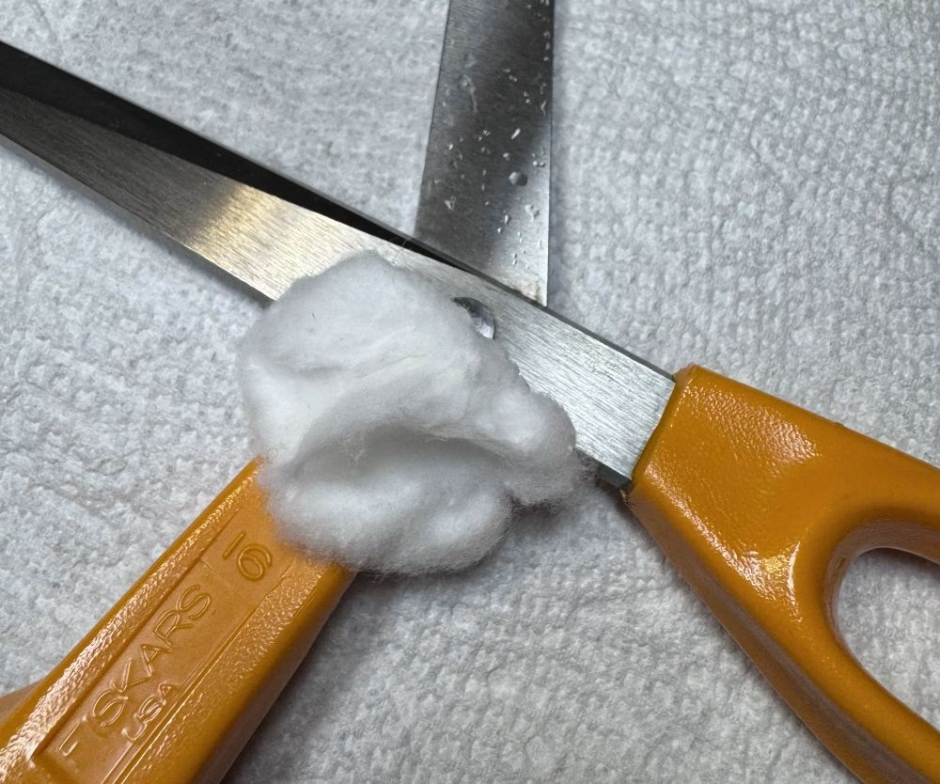
If your scissors are very rusty, I have heard leaving them to soak for a day in vinegar is a great option. Since mine just had a few spots, I soaked a cotton ball in vinegar and left it to sit on the different spots for a couple of hours each. It didn’t completely eliminate the problem but it does look a lot better.

Then when all this is done, wipe down with a clean cloth again.
Oiling Your Scissors
Aside from the blades, the joint where the scissors are held together is the most important part, and a post on how to clean scissors wouldn’t be complete without talking about oiling them as well.
Some scissors have an actual screw at this joint that can be loosened, and if your scissors have that and are feeling looser than you’d like you can tighten them here.

Mine just has a flat knob that doesn’t move, so I used a bit of sewing machine oil (which you already have for cleaning your sewing machine, right?) around the edges on each side of the scissors. If your oil has a tube like mine, you can use that to spread the oil around, or use a cotton swab or your fingers.
Allow the oil to sit, and open and close the blades a few times to help the oil get into the join. Wipe your scissors down again after this to make sure there’s no extra oil on them that could get onto your fabric.
Sharpening Scissors
The best bet for sharpening your fabric scissors is always going to be a professional sharpener. People who sharpen knives can also sharpen scissor blades. A local-to-me shop will sharpen a pair of fabric shears for $15, which is definitely worth it if you have high-end scissors that you expect to last for decades.

For my old pair of shears, which is not my primary set of fabric scissors anymore anyway, I went the lazy route and sharpened them by cutting through a piece of aluminum foil a few times.

I’ve done this on my regular all purpose craft scissors and went from being so annoyed I wanted to throw them away to suddenly using them for everything again. It’s certainly not as good as professional sharpening (and indeed not as good for the blades, I’m sure) but it’s also better than nothing.
Once you’ve gotten your scissors in good shape, it should be easier to take care of them and keep them working well. One additional tip: if your scissors came with a sheath, use it! This helps keep them from getting damage if they’re dropped, for example, and can also prevent injuries. Some day I’ll sew a scissors case but you can keep them in any little bag you have handy if you don’t have a sheath.
How often do you clean your scissors? Now that you know how to clean scissors I hope you’ll do it more often (and yes, I’m writing this for myself, too!).