Affiliate links may be included for your convenience. View our privacy and affiliates policy for details.
Don’t let holes in your T-shirts keep you from wearing them; let’s look at some easy T-shirt mending methods you can do with little to no sewing experience!
Why Holes Happen
Holes in T-shirts are a super common problem. They can develop for lots of reasons, from regular wear and tear to getting roughed up in the laundry.
The thinness of modern fabrics means it’s not unusual for shirts to develop holes, especially around points of friction. If you tuck your shirts in, for example, you’ll probably find your shirts getting holes along the tuck line because of the friction caused by your pants rubbing on the fabric. (This can happen if you don’t tuck, too.)
You can also get friction holes in other places that see frequent friction, like where the strap of your bag or your seat belt hits, the counter top if you work at a counter you regularly lean on, things like that.
The zipper of pants can also catch shirts in the washing machine, causing little holes. And you can get T-shirt holes anywhere on the garment, not just at the waistline (in fact all the T-shirt mending in this post is places other than the bottom of the shirt).
T-Shirt Mending for Small Holes
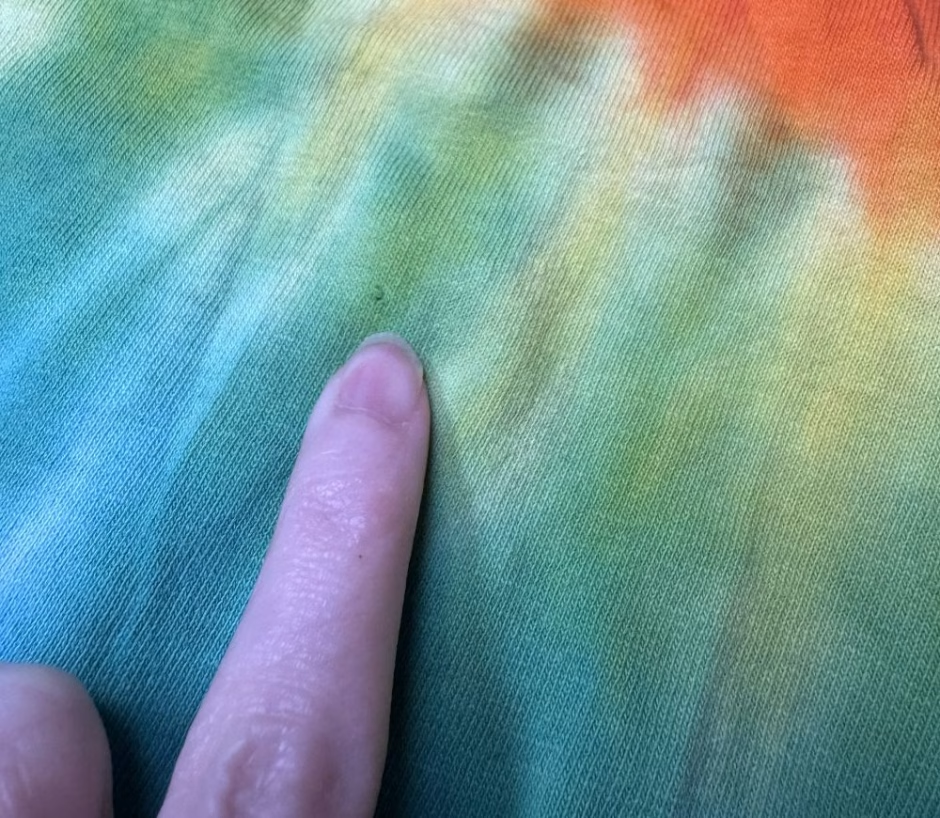
If you happen to catch a hole when it’s still tiny, it’s a really easy fix. This hole on the sleeve of a long-sleeve shirt that’s older than my daughter caught my eye in the mirror the other day, and it’s only one stitch in size.

Grab some cotton thread (coordinate or contrast, it’s up to you, but I used white so you can see it) and a sewing needle. Tie a knot in the thread and take the needle from back to front through the fabric below the hole.

If you can still see the loop of loose thread where the hole started, take your needle through that. Otherwise, just take the needle through the fabric above the hole, making a little stitch but keeping the needle at the front of the fabric.

Then take the needle down and through the fabric from front to back in the same place (or as close as you can get) where you came up on the first stitch. This makes a little v of stitching that mimics the knit fabric of a T-shirt, and if it’s worked in coordinating thread it’s pretty hard to see.
If you’re a knitter you’ll know this move as duplicate stitch.

With the thread still on the back side you can also stitch through the fabric over the hole to reinforce the mend if you like. Tie a knot and trim the excess thread.

Mending Larger Holes

That T-shirt mending task was pretty easy, but then we come to a shirt that’s a bit more of a project.
If you’ve been here for a while, you might notice that the flower on this shirt was originally done as a visible mending project to mend a hole. It’s nice to see it still looking good nearly three years later!
But as sometimes happens with mending, some of the fabric near that mend has gotten worn out as well, leaving me a collection of new holes. I dealt with them in different ways so you can think about what’s best for the holes you have.

First there was a series of little holes I fixed in the same duplicate stitch kind of way as the stitch above. Here I didn’t have the original threads to work with so I just did the best I could to cover the holes.

Next up a bigger hole I fixed with a bit of weaving. To start, anchor your thread and make a few long stitches that cover the hole in one direction.

Then do over and under weaving, taking a stitch into the fabric at the end of each “row” until the hole is covered.

I didn’t try to make this perfect, because this is an undershirt, but if you want denser stitching you can absolutely do that.

The final big hole looked kind of like a heart to me, so I patched it with a piece of T-shirt material underneath and sewed around the edges. This is like my reverse applique patch. It didn’t end up looking much like a heart, but it was still fun.

Now I’ve done all the T-shirt mending that needed doing. Even though this is one no one else sees, it’s nice to take the time to patch holes so they don’t keep growing.
Do you have anything you need to mend that you need help with? Let me know!