Affiliate links may be included for your convenience. View our privacy and affiliates policy for details.
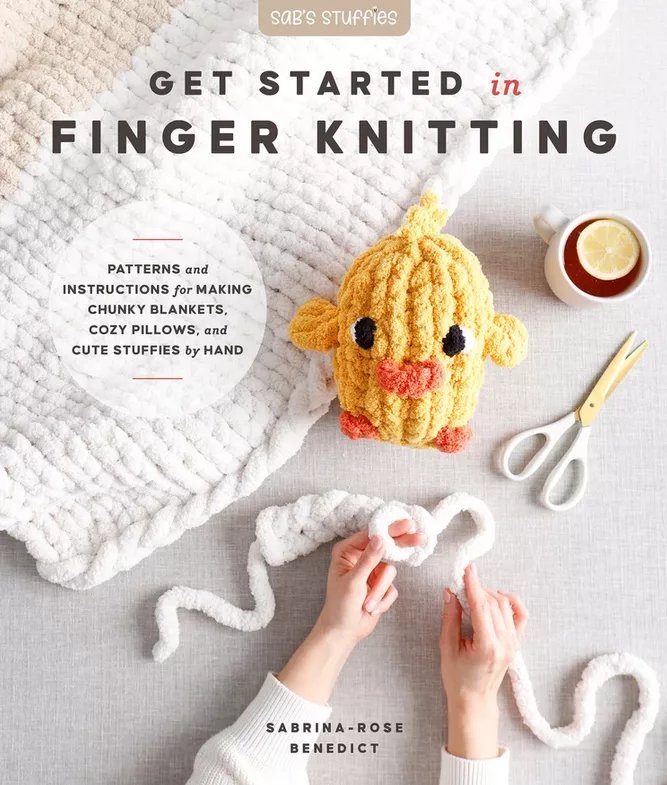
Get Started in Finger Knitting by Sabrina-Rose Benedict is a guide to knitting without needles, with 16 patterns for softies (and one blanket) for beginners to try.
Finger Knitting Versus Knitting with Fingers
Once I got a comment on Pinterest that a project I shared (a finger knit basket) wasn’t really finger knitting. I didn’t know what to say to that because I made it, and I used my fingers to do it.
But I think the person may have been defining finger knitting the way that Benedict does in Get Started in Finger Knitting.
The method I was using involves actually putting the loops on your fingers, wrapping the yarn around each one and pulling the old loop off. It’s more like loom knitting than knitting with needles.
This version of finger knitting involves making a chain like you would for crochet, using your fingers to hook the yarn. Then you pull a loop up through each chain, leaving them all open as you work your way across.
Without turning the work you then pull a loop through each loop again, working in the opposite direction.
Finishing is similar to finishing a potholder loom project, where you put one loop into the next across and then finish off.
You can also work in rounds, work increases and decreases and change colors.
Learning Finger Knitting
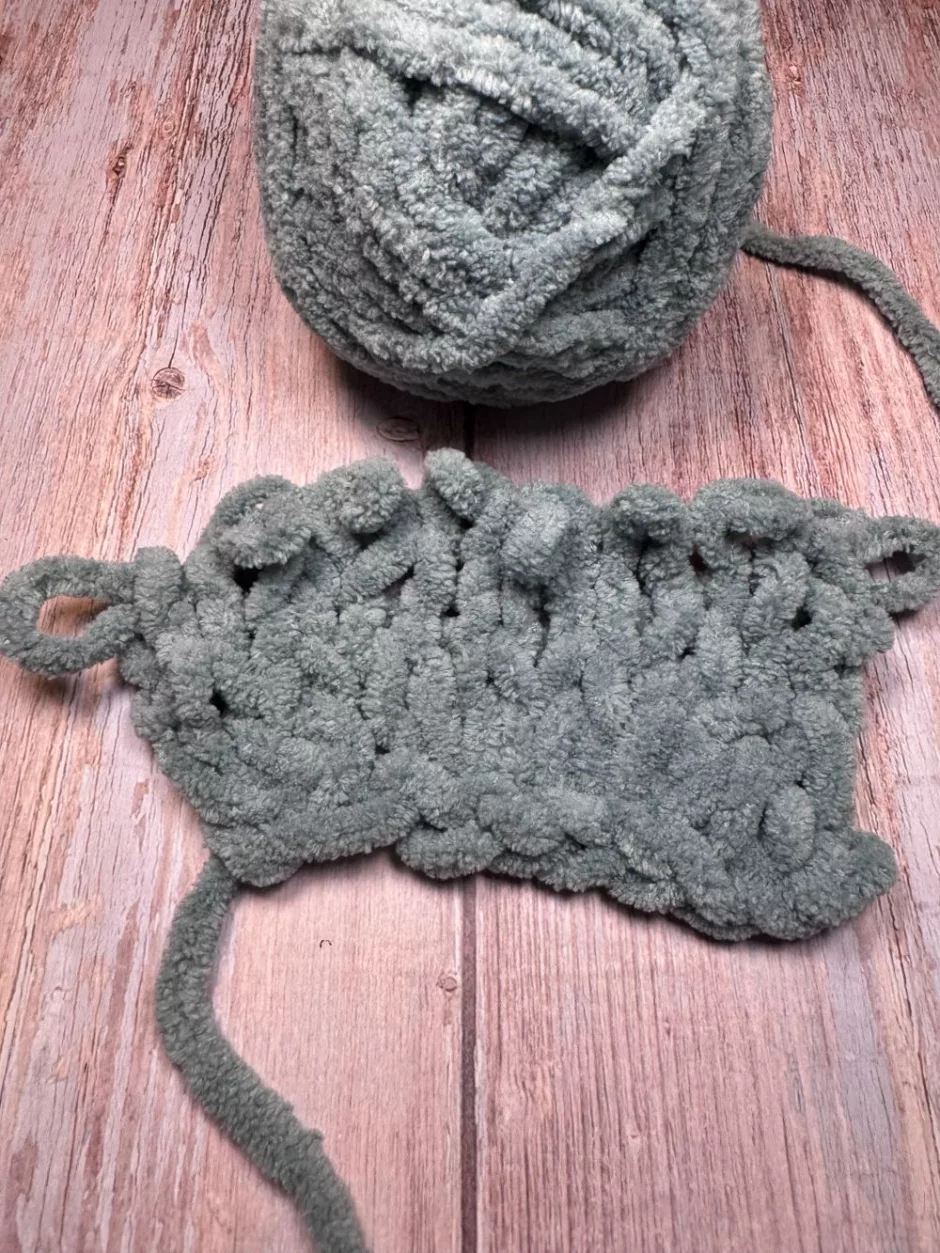
I’d actually never done finger knitting like this before (though I have worked with loop yarn, which is a similar concept, here you just have to make the loops yourself) so I decided to give the instructions in the book a try and see how easy it was.
First I’ll say all the projects in the book call for jumbo or size 7 yarn, which I don’t have in the house, so I used some super bulky/6 instead (Bernat Blanket, of course). I feel like that might have been the cause of some of the tension problems I had, because the jumbo yarn might hold in place better rather than the stitches becoming progressively smaller as you work the next one.
Making sure all the loops are the same size is important, and on this swatch I actually worked the first row by putting all the loops on my finger before working back across. That helped them stay the same size but isn’t really a solution if you have more stitches than the length of your finger.
Also the basic techniques section of the book is a little lacking in telling you how to finger knit. There’s a page on making the chain and one on doing the knit stitch, and then it moves on to fixing skipped loops, changing colors and working in the round without explaining how to knit the next row or finish your project.
The knitting in the round section is more detailed, which makes sense because almost all of the patterns use that technique, but it’s good to practice flat first.
If you know how to knit or crochet you can probably intuit what you need to do, but if you need more instructions than that, head to the blanket pattern, where there’s a better tutorial.
Get Started in Finger Knitting Projects
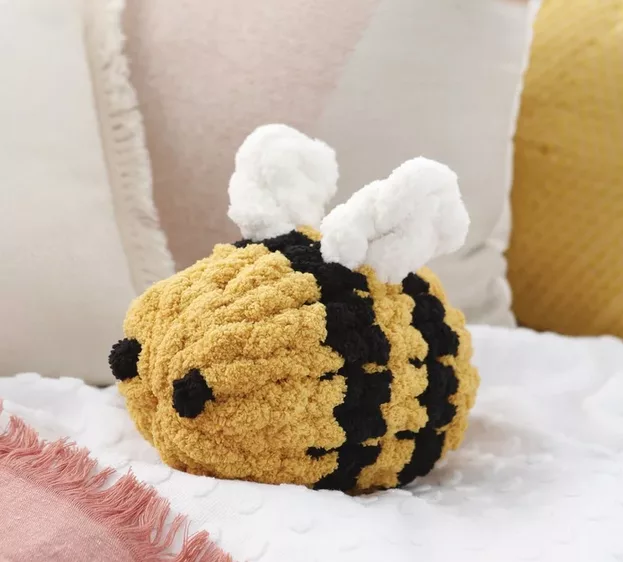
After the instructional section, there are 17 patterns in the book. There’s a blanket, a bolster pillow and a stress ball, and the rest are toys worked in the round. All but two (an elephant and pig) are rated either for beginners or confident beginners.
The projects mostly use similar shapes, and sometimes the same shape. The hen pattern, for example, is used with variations in features to also make a yellow duck, mallard duck, eagle and flamingo. The whale, shark, walrus and seal are also all built on the same pattern.
Seeing the same pattern used different ways might inspire stitchers to make their own favorite animals, but it feels like a bit of a bummer that there’s not more variety in shapes and techniques. To me it doesn’t really feel like 17 patterns when it’s the same thing over and over.
The projects are cute, and I like the bumblebee and octopus, and the pickle is a nice nod to whimsy, but unless I had little kids to knit for I don’t think I’d make more than one or two projects from the book.
You also only learn the knit stitch and mostly only work in the round for these projects. I don’t feel like it would have been hard to include more flat projects (like a scarf or a rug) and more projects in general that aren’t toys (maybe a basket or other home decor?).
I know that the author is known for stuffies and sells kits and tutorials for different projects on her website. But still I feel like the book shows a bit of a lack of imagination in not trying to do some other things with the technique.
Worse I feel like there’s a lack of curiosity about using the technique in other ways, too. She says “I personally have only ever used chunky chenille-type yarn for my projects” and recommends other options she has never actually used. These projects are pretty fast; it wouldn’t have taken her that long to try a super bulky or a different kind of yarn and see what happened. Even if she still only used the jumbo yarn in the patterns, then at least she could recommend alternatives from a place of knowledge.
That said, if you want to learn how to knit with your fingers and you like the little stuffies that make up most of the patterns in the book, Get Started in Finger Knitting is a good place to start with finger knitting. Now that I know how to do it maybe I’ll make some of those projects I wish she had done!
Check out the publisher’s website to get a preview, and you can buy direct from them or grab a copy on Amazon.